
Designing for Circularity: How SC Johnson Is Rethinking Packaging Across Product Platforms

For many of us, the shift to more sustainable packaging shows up in small but familiar ways: a refill bottle that looks different on store shelves, a cleaning product that comes in a lighter bottle, or a concentrate that uses far less material.
More and more companies are rethinking how their packaging is made — redesigning it to cut waste, use fewer raw materials, and keep plastic in circulation longer. The latest Ellen MacArthur Foundation Global Commitment Progress Reportshows what that kind of coordinated action can achieve. According to the report, business signatories have avoided using 14 million tonnes of virgin plastic, effectively keeping one barrel of oil in the ground every second since the initiative began. Together, they’ve tripled the use of recycled content and eliminated billions of problematic plastic items from circulation.
SC Johnson has been part of that effort since joining the Global Commitment in 2019. Over that time, in packaging, the company has reduced its total plastic footprint by 15% (about 12,000 metric tons), cut virgin plastic use by 33%, and increased post-consumer recycled content to 25%. Today, 64% of its plastic packaging is recyclable, a figure that continues to rise as new designs roll out.
And by 2030, the company is targeting 55% inclusion of recycled content in plastic packaging and a 55% reduction in virgin plastic, compared to 2018 levels.
That progress is more than a milestone; it’s a springboard. Having met its initial goals early, SC Johnson is now focused on what comes next: applying multiple circular design principles across entire product platforms.
When Progress Meets Practice
Circular design is rarely a straight line. Every change comes with tradeoffs. What looks simple on a store shelf is often the result of dozens of choices: which materials to use, how much plastic to remove, and learning what works and what doesn’t. A refill might reduce waste, but it can also ask more from consumers.
That’s what happened in 2011, when SC Johnson launched a concentrated Windex® refill. The idea was straightforward: pour a small packet of concentrate into an empty spray bottle, add water, and reuse the same bottle again and again. Each refill used 90% less plastic packaging than a 26 fluid ounce trigger bottle, and since the trigger sprayer can account for more than a third of a bottle’s total weight, reusing it made an even bigger impact.
On paper, it was a smart way to cut plastic waste. However, most shoppers opted for ready-to-use bottles. Some assumed concentrates wouldn’t clean as well. Others simply preferred convenience, a primary driver of the "Why reuse when you can replace?" mantra of the single-use culture. Even for those who are inclined to make more sustainable choices, studies show that they often find those choices hard to keep up with when they require extra steps.
That experience provided a valuable insight: progress only works when it works for people. Sustainable packaging must feel familiar, practical and intuitive, and it should be something consumers want to use, not just something they know they should use.
Redesigning for Connection
That same insight resurfaced a few years later with method® hand soap refills. The brand had replaced its flexible plastic pouches, which are difficult to recycle in most U.S. communities, with bottles made from high-density polyethylene (HDPE), a plastic that can be widely recycled through curbside programs.
Technically, the switch was a success, but as with the Windex® concentrate, the new design didn’t land quite as expected. Adoption was slow. Some shoppers saw the larger refill bottles as heavier or less sustainable than the pouches they replaced. Others didn’t recognize which refill matched their starter bottle, since the design didn’t clearly connect to the rest of the method® line.
The team took those signals and went back to the drawing board. They reworked the bottle’s shape to make it look and feel more familiar, lightened the overall weight to reduce material use and incorporated 100% recovered coastal plastic. They also redesigned the label and color system to make it clear which refill belonged with which product, a small but important detail that made refilling easier and more intuitive.
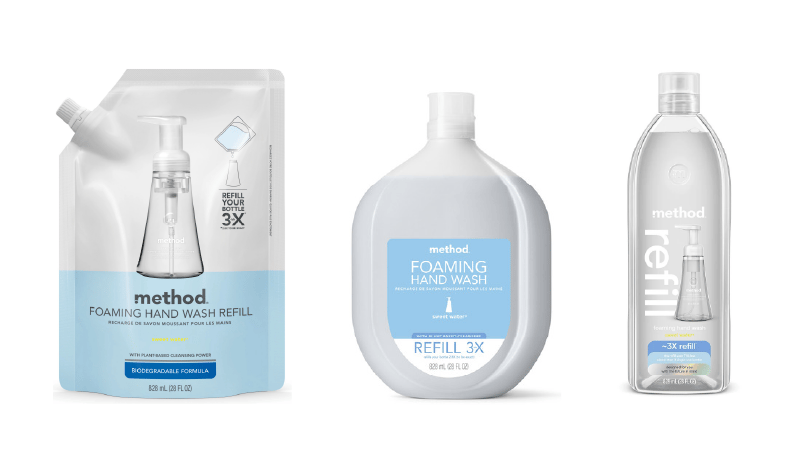
method® products from left to right, flexible plastic pouch, high-density polyethylene (HDPE bottle) and100% recovered coastal plastic bottle.
The result wasn’t just a more recyclable package but a better consumer experience. The bottle now looks unmistakably like part of the method family and helps connect sustainability to the things people already value about the brand: quality and ease of use. That same design thinking is now being applied to other method products, such as dish soap refills and cleaning sprays.
The same principle of rethinking design is showing up in other SC Johnson products as well.
Those Windex® concentrated refills mentioned earlier? Despite the initial slow uptake, the company stuck with them and has continued to incorporate more circularity principles into the product line. In North America, all Windex® PET bottles are now made with 100% recovered coastal plastic, part of a broader effort to close the loop on materials that might otherwise end up as waste. Each durable trigger bottle can be reused up to eight times with either concentrate or value refills, reducing single-use plastic by about 50%. That has helped avoid nearly 2,000 metric tons of plastic in one year.
Together, these changes form a pattern: multiple circular design principles that started as individual innovations are now being integrated into how products are designed from the start.
What Circularity Means for All of Us
Circularity isn’t just a business strategy. It’s a practical shift in how everyday products fit into people’s lives. When companies design better, it gives people better choices.
That matters because sustainable decisions look different for everyone. A person who has just learned about “wish-cycling” might focus on avoiding black plastic, while someone more familiar with circular design might look for packaging made with post-consumer recycled material. For one person, a refill might feel like a small step; for another, it’s a major change.
Ultimately, the most effective approach to being more sustainable involves individuals finding meaningful and manageable ways to integrate these principles into their own lives. Refill instead of replace. Reuse instead of toss. Choose recycled over new. Each new action may feel small, but together they create a ripple effect, shifting entire systems toward a future where being more sustainable isn’t an extra effort – it’s simply how things work.