
Frank Lloyd Wright and H.F. Johnson, Jr.: A Legendary Partnership for American Architecture

The phrases “innovative architecture” and “office building” are rarely found together in the same sentence. And especially not before World War II. Barring a few notable exceptions — the Chrysler Building in New York City and the Louis Sullivan building in Chicago — office buildings in the early part of the 20th century were built to fulfill a function, rather than to emphasize a form.
That is until H.F. Johnson, Jr., third-generation leader of SC Johnson, commissioned Frank Lloyd Wright to design an office building for Johnson Wax in 1936.
Anybody can build an ordinary office building. I wanted to build the best office building in the world, and the only way to do that was to get the greatest architect in the world.H.F. Johnson, Jr.
Third-generation leader of SC Johnson
 Harvesting leaves from the carnaúba palm.
H.F. returned home to Racine, Wisconsin with a renewed purpose. He would lead the company through marketing triumphs, hire Frank Lloyd Wright to design our headquarters, launch innovative employee benefits and more.
But the journey remained with him. Capturing its stories in a book for his family, he wrote to his son, Sam: “I hope you make this trip some day. It changed my life.” His words led Sam to his own Carnaúba Expedition sixty years later. And the wonder of both those expeditions continues to inspire us at SC Johnson today.
Before H.F. passed away in 1978, he had one final request: He wanted the carnaúba leaf carved into his tombstone. More than a plant, the leaf had come to symbolize the values that H.F. prized so highly and for which he is gratefully remembered.
The Raposa research center, founded by H.F. Johnson, Jr. in 1937 in Fortaleza, Brazil.He had a Lincoln-Zephyr and I had one; that was the only thing we agreed on. On all other matters we were at each other’s throats.H.F. Johnson, Jr.
Third-generation leader of SC Johnson
Our Frank Lloyd Wright-designed Headquarters Put SC Johnson on the Map
Considered a gamble by some, H.F.’s vision and Wright’s remarkable designs marked them both as pioneering visionaries. The SC Johnson Administration Building is celebrated to this day as one of the top 25 buildings of the 20th century.
From its 43 miles of Pyrex glass tubing to the dendriform columns soaring in the Great Workroom, it is truly a unique work of art that reflects that innovation and adventure that are fundamental to the spirit of SC Johnson.
And the partnership didn’t stop there. In addition to the Administration Building, H.F. and Wright constructed the Johnson family home, Wingspread in Racine, Wisconsin. And, in 1950, H.F. opened the Wright-designed SC Johnson Research Tower, a state-of-the-art laboratory on the SC Johnson campus.
With the addition of each architectural masterpiece, the SC Johnson brand grew, too.
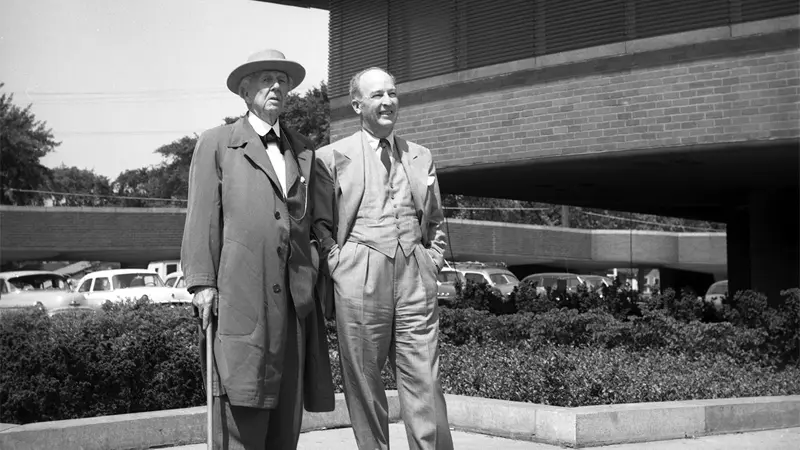
Today, the collaboration between H.F. and Wright is a celebrated part of our family lore and of architectural history. These visionary leaders together produced some of the most enduring and inspiring examples of American architecture – even though sometimes they did it while scolding each other across the phone lines.
In one of his many letters to H.F., Wright wrote that the architecture of SC Johnson would act as “...a torch lifting to the sky to inspire your people around the world.”
What H.F. knew in the 1930s, we still live by today. Great architecture has the ability to reflect the soul of a business and attract creative minds to solve the problems of the day.
It is there, among the beauty of our buildings, that some of our greatest ideas take shape.
More on H.F. Johnson, Jr.

H.F. Johnson, Jr.’s Carnaúba Expedition was a Life-Changing Adventure

“Fibber McGee and Molly” – How the Golden Age of Radio Made Johnson a Household Name
