
Life in the Research Tower: Looking Back on the Moments that Make a Legacy

Office workspaces have changed dramatically in the last 75 years. The chairs we sit in, the tools we use and even where we work look very different from what they once did. Yet some workplace experiences have remained remarkably consistent.
Take the slow elevator.
You stand waiting alongside someone you’ve seen around the office before. You debate whether to make small talk or stare straight ahead and pretend you don’t notice them. Maybe you mention a problem you’re working through. Maybe they offer a different perspective. A few minutes later, you step off with a creative spark in your mind. Unknowingly, they’ve just helped you on your path to finding a resolution.
Would it surprise you to learn that scientists working in the Research Tower at SC Johnson’s headquarters in the 1950s had much the same experience?
With fifteen floors and a single elevator, waiting was simply part of life in the Tower. Scientists regularly found themselves standing together between experiments, meetings and tests. Conversations started. Questions were asked. Ideas were exchanged. What seemed like a routine part of the workday often turned out to be something more valuable.
Those moments may have appeared insignificant at the time, but they were part of something much larger.
Today, the Research Tower is often remembered as a symbol of innovation. Brands such as Raid®, Glade®, Pledge® and OFF!® all trace part of their story back to the scientist who worked inside its walls. Fourth-generation leader Sam Johnson once said SC Johnson became a “different company” the day the Tower opened.
But the Tower’s legacy wasn't built by breakthrough moments alone. It was built through thousands of everyday interactions between the people who worked there. In other words, the Tower’s true legacy was not just what was discovered inside it, but how people worked together to make those discoveries possible.
Built to Bring People Together
When third-generation leader H.F. Johnson, Jr. decided to expand the company’s research and development abilities and establish a facility in the 1940s, he turned to Frank Lloyd Wright to help imagine what the future might look like.
SC Johnson was, at this time, still a floor wax company. As it would be located in close proximity to the Wright-designed Administration Building, which was built less than five years prior, it made sense to give Wright the chance to submit his own ideas for how this facility should be constructed.
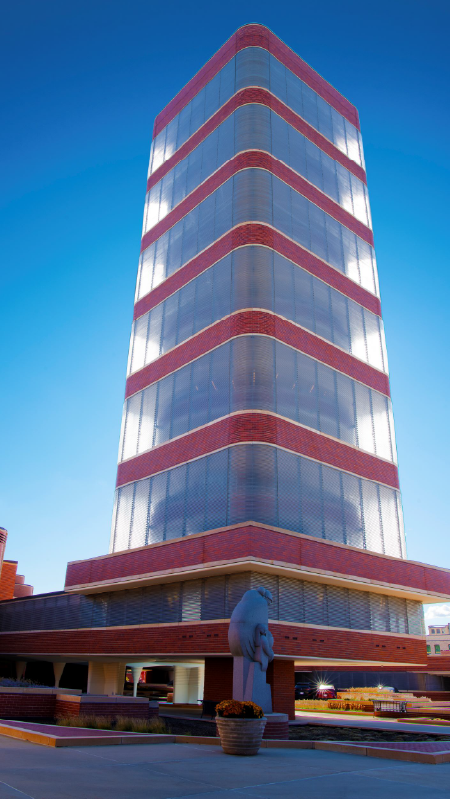
The design he came back with looked unlike almost any laboratory of its time. Rising above the surrounding campus, the Tower became one of the most recognizable structures in Racine. Yet what made it special wasn't simply how it looked. It was how it worked to bring people together.
Each department occupied a square laboratory floor and a smaller, circular mezzanine above it. The mezzanines remained open rather than enclosed, making it easier for scientists on neighboring floors to communicate and share ideas.
In the book Frank Lloyd Wright and the Johnson Wax Buildings, this setup was even said to have inspired camaraderie and uplifted morale by making it easy to communicate with partner floors. One scientist recalled to author Jonathan Lipman that they could now work near six other scientists, rather than just the one or two a standard lab setting had space for.
That difference mattered. Ideas rarely stayed confined to a single desk, project or floor. Scientists routinely crossed paths with perspectives they might never have encountered elsewhere. The building created opportunities for interaction that became part of daily life.
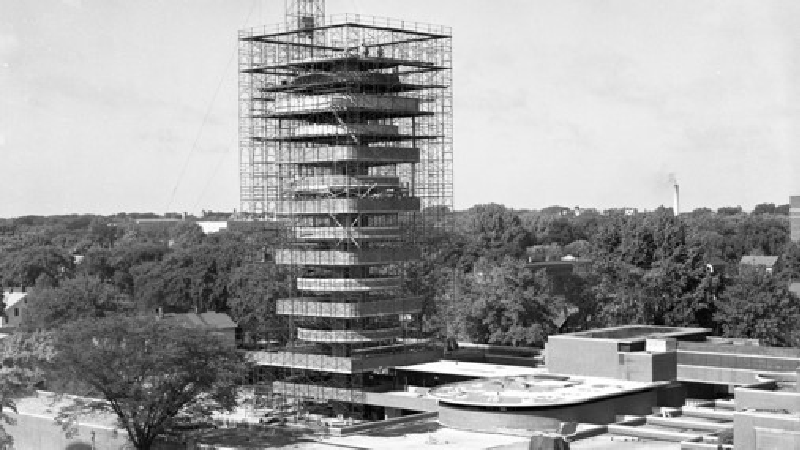
Construction of the Research Tower
Room to Think
For some scientists, the Tower’s greatest innovation wasn’t architectural at all. It was simply space to flourish.
Before moving into the Tower, many researchers worked in older facilities where room was limited, and resources were stretched. The new building offered something different: room to think, room to experiment and, for many, a workspace of their own. Water, power and equipment were readily accessible. Everyday tasks became easier. Experiments became more efficient. More room to breathe meant more room to take notes, prepare experiments and complete tests.
The Tower wasn't designed solely by architects. J. Vernon Steinle, director of the Research and Development Division at the time, and other department leaders were invited to help shape the building’s interior, including input on which equipment to use and the layout throughout the Tower. A full-scale model of a Tower floor and its mezzanine was even created[TB9.1] in a parking lot on campus so they could test layouts and make adjustments before construction was completed.
The result was a workplace built around the needs of the people who would spend their days inside it. Steinle later credited this thoughtfully curated environment as one reason morale and productivity remained so high among the scientists who worked there.
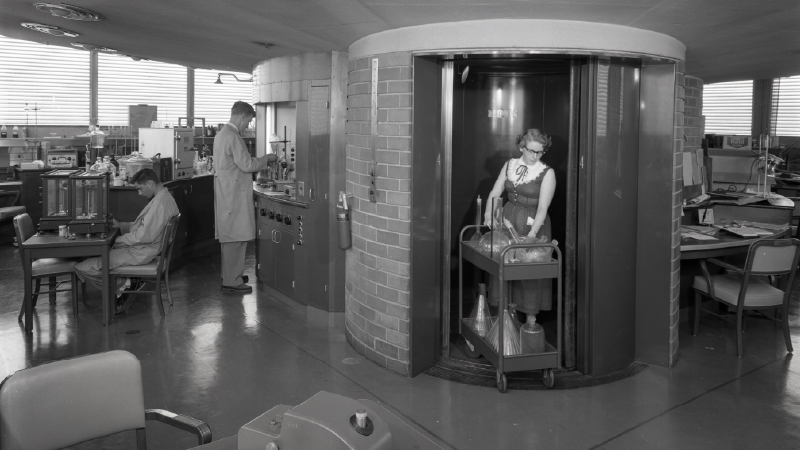
Interior of the Research Tower in 1955
Learning Was Part of the Job
The Tower wasn't just changing where people worked. It was helping shape what kind of scientists they could become.
Following World War II, research and development departments across industry began shifting their focus. Scientists were no longer focused solely on improving products. They were increasingly interested in understanding the science behind how those products worked.
SC Johnson invested in that shift. The company recruited more university-trained scientists and introduced programs that helped employees continue their education. Tuition assistance and professional development support created opportunities for people to expand their expertise throughout their careers.
The Tower became a place where curiosity was encouraged, questions were welcomed and knowledge was continually expanded.
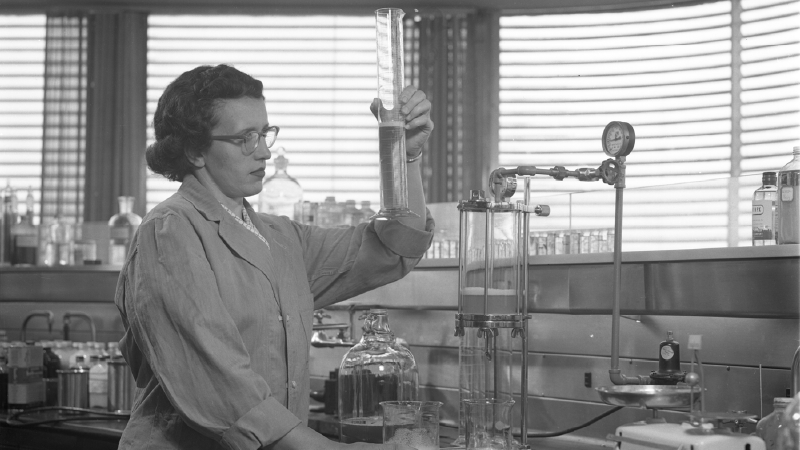
SC Johnson Chemist, Marge Rendall, in 1954
More Than a Workplace
Of course, life inside the Tower wasn't all experiments and research papers. Like any workplace, it was filled with small moments that brought people together. One of the most famous examples involved the building's dumbwaiter.
Originally installed to transport materials between floors, it eventually became a vehicle for harmless pranks. Scientists were known to send balloons to an unsuspecting colleague or leave a toy mouse waiting for the next recipient to discover.
The building's plumbing occasionally created its own surprises. Because utilities ran up through the building’s central core, stories circulated of shampoo poured into a sink on one floor somehow appearing in a toilet several floors below.
Working Inside a Landmark
Anyone who has ever worked in one of Frank Lloyd Wright's SC Johnson-designed buildings will tell you it offers a unique set of experiences. The Research Tower was no different.
Some were inspiring. Many scientists later recalled feeling proud to work in such an unusual and celebrated structure. Sam Johnson would later say the Tower helped attract creative people because it signaled that the company valued new ideas and the people behind them.
Others were less glamorous. Wright described the building as a "helio-lab," a laboratory filled with natural light. However, during parts of the day when the sun’s rays hit the glass tubes on the outside of the building just right, a glare was created. The issue was so rampant that some scientists eventually took matters into their own hands, hanging up makeshift curtains.
Others requested sunglasses. One scientist recalled entering a floor during the afternoon and seeing so many colleagues wearing sunglasses that it looked as though everyone should be “on the beach in mid-July” rather than conducting research.
When the Work Moved On
For more than three decades, scientists climbed the Tower's floors, shared ideas across its laboratories and helped shape the company’s future. Eventually, however, the building faced a challenge it could not overcome.
The Research Tower notably had a single stairwell. As fire safety codes evolved, that design no longer met modern requirements. In 1982, SC Johnson faced a difficult decision: either significantly alter the Research Tower or preserve its original design.
After consulting with Frank Lloyd Wright’s apprentices at Taliesin Associated Architects, the company chose preservation. Research operations moved elsewhere on campus, and the Tower's days as a working laboratory came to an end.
A Legacy Continued
Thirty-two years later, after large-scale renovations, the Research Tower reopened in 2014, but not for research. Instead, just the third floor and its accompanying mezzanine were opened to host public tours, inspiring the next generation.
Visitors who step inside today often arrive expecting to learn about architecture, innovation or the products that emerged from the Tower that shaped SC Johnson's future. But they also discover something else: the Tower's story is ultimately a story about people.
It's about scientists who spent years solving problems together. It's about conversations that happened between experiments. It’s about shared jokes sent through a dumbwaiter, improvised curtains hung against afternoon glare, and ideas exchanged while waiting for an elevator. In the end, the Tower shows how those everyday moments helped shape what came next.
As the anniversary of the Tower’s opening approaches, these stories remind us that innovation may be remembered through breakthroughs, but it is often created through the people, places and experiences that make those breakthroughs possible.