
Getting the Scoop on just what Scope 1, Scope 2 and Scope 3 Emissions are

You've probably heard a lot of companies talk about their "carbon footprint" and “GHG emissions” and how they are working to reduce them. That’s a good thing – But how do you know what any of it means?
Carbon footprint reporting is one of the methods companies use to understand their carbon impact and highlight their efforts towards more sustainable business practices. Many businesses are now tracking their emissions of greenhouse gases, which is a mixture of gases like carbon dioxide and methane that absorb heat energy, and taking steps to mitigate them.
This information is crucial as a measure of transparency, and as a means for businesses to demonstrate their dedication to more sustainable business practices. Most organizations reference the Greenhouse Gas Protocol (GHG Protocol) to help identify and calculate their emission metrics.
And, it turns out, these measurements are a big deal for shoppers. In one recent survey, 37% said they really want companies to cut down on CO2 and energy use. But here's the twist: more than three quarters of people – 78% – admit to being a bit lost when it comes to figuring out which companies are actually making tangible progress on their sustainability commitments.
This article walks through the different elements businesses use when calculating their emissions and will ultimately help consumers make informed decisions about the companies they purchase from.
Breaking it Down: What are Scope 1, 2 and 3 Emissions
Developed in 1998 through a collaboration between the World Resources Institute and the World Business Council for Sustainable Development, the GHG Protocol provides a standardized framework for both private and public sector organizations to measure and manage the amount of greenhouse gases they emit. This is essentially like a school report card for larger emitters.
Emissions are separated into three categories: Scope 1, Scope 2 and Scope 3.
Scope 1 Emissions
Scope 1 emissions are the direct greenhouse gas emissions that come from sources a company owns or controls. The key word is "direct,” meaning emissions caused directly by processes and equipment of the business.
For a company, these emissions could come from their manufacturing processes. Examples of this include the burning of natural gas or diesel in boilers, using furnaces at a company-owned manufacturing site, or the emissions from company-owned vehicles. So, if you see a delivery van driving around or notice a bakery’s oven puffing out smoke, those are examples of Scope 1 emissions.
Scope 2 Emissions
Scope 2 emissions are indirect emissions from utilities, such as electricity or steam, that a company purchases to run its operations. These emissions are considered indirect because the company doesn't own or control the facilities that produce the energy, but they are still accountable for the emissions generated.
Emissions in the Scope 2 category can be impacted by the energy source used to generate electricity, heat, or steam. Energy sources include coal, natural gas, wind, solar and more. The company purchasing the utilities considers these emissions to be Scope 2, while the company that generated the utilities would measure the emissions as Scope 1.
Ways to improve these emissions include utilizing renewable energy, electrifying fossil-fuel consuming equipment, switching to electric corporate vehicles and adopting company-wide energy efficiency and recycling policies.
Emissions that make up the Scope 3 category, on the other hand, are much more complex to measure and reduce.
Scope 3 Emissions
Scope 3 emissions are indirect emissions beyond a company’s immediate control. They encompass all the indirect emissions throughout a company’s entire supply chain and the lifecycle of a product or service. Imagine you're holding a smartphone; the materials mined for its production, the energy used in manufacturing and even the transportation involved in delivering it to your hands contribute to the Scope 3 emissions of the companies involved.
Scope 3 emissions include everything from raw material extraction to product disposal. It's a complex web that goes past a company's doorstep, touching every step of a product's journey to you and beyond.
This wide spectrum makes Scope 3 emissions the most challenging to measure, as well as the most difficult to reduce. Currently, reporting of Scope 3 emissions for most organizations is voluntary, but it is believed these types of carbon emissions account for over 90% of a business’s total carbon emissions. This means an organization’s work to regulate and reduce these emissions has the potential to have a large impact.
How SC Johnson is Working to Reduce their Environmental Impact
SC Johnson has a long history in working to reduce its environmental impact. For example, in 1975 the company chose to remove chlorofluorocarbons from its aerosol products, which was three years before a mandate was put in place by the U.S. government. This decision has been considered by some to be one of the most important business moves made to help the planet.
A key reason: As one of the first large companies to take a public stance against a substance that harmed the environment, SC Johnson helped set the tone for future corporate environmental efforts.
In 2024, SC Johnson exceeded their goal to reduce their absolute Scope 1 and 2 GHG emissions by 70% compared to its 2000 baseline. SC Johnson reduced GHG emissions by 71% a year ahead of schedule. Reductions have been achieved through a mixture of investments in sustainable design innovations, incorporating more energy efficiencies in the manufacturing process and utilizing more low-carbon fuel sources and renewable electricity.
To address Scope 2 emissions, SC Johnson has continued transitioning to a variety of renewable energy sources. Now, 45% of the company’s energy consumption comes from renewable sources such as on-site generation and purchased renewable electricity. In 2024, over 8,300 solar panels were installed at SC Johnson’s largest manufacturing site, named Waxdale, in Mount Pleasant, Wisconsin. In total, the company now has nearly 19,000 solar panels across their sites around the globe.
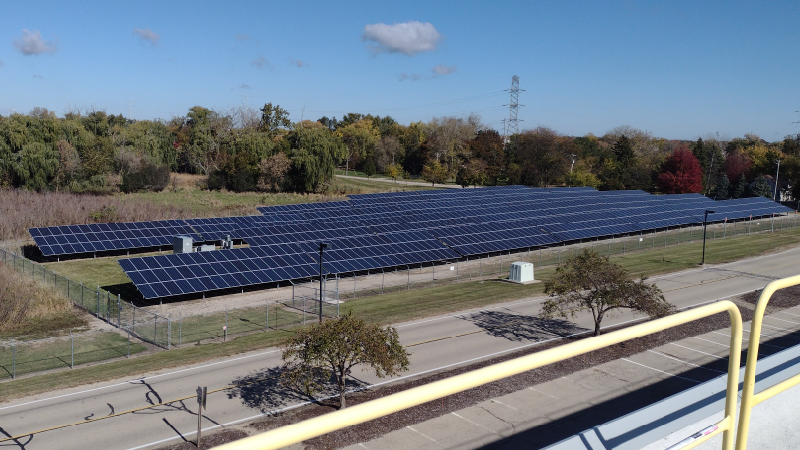
Waxdale has also been using energy generated from two on-site wind turbines since 2012. On average, these turbines produce 7 million kilowatt-hours of electricity annually, which is enough to power nearly 700 homes. Since 2020, these turbines have reduced the site’s GHG emissions by almost 3,500 metric tons. Today, the site utilizes 60% renewable electricity through these on-site solar and wind generation activities, landfill gas and purchased green electricity.
SC Johnson is also working to deepen their understanding of and reduce their Scope 3 emissions. One way they’re doing so is through an ambitious plastics sustainability strategy to us less virgin plastic, incorporate more post-consumer recycled materials and make more of their packaging reusable and recyclable.
In early 2025, Ecover launched All-In-One and All-In-One Power, the new dishwasher tablets with 40% more enzymes for improved stain removal. They are packaged in a dry, concentrated tablet form with no plastic wrapper. The tablets also use a smaller, compact, recyclable box with a minimum of 60% post-consumer recycled cardboard. The reduced size decreases the amount of shipping materials needed and the product’s plastic-free coating reduces the amount of plastic utilized in the manufacturing process.

Maintaining a Steadfast Commitment to Reducing Emissions
The effort needed to accelerate global progress on reducing GHG emissions goes beyond SC Johnson or any single company. To drive transformational change, a collective responsibility for businesses and industries is needed to continually seek innovative solutions and embrace renewable energy sources.
SC Johnson is committed to reducing GHG emissions across their operations and value chain. Progress is made through collaborating with stakeholders across the value chain, including customers, consumers and regulators, to identify decarbonization opportunities and co-create solutions that benefit both people and the planet. The progress SC Johnson has made in emissions reduction so far reflects the company’s long-standing dedication to environmental stewardship.